Chasing Calm: How Your Wellness Podcast Habit Might Be Feeding Your Anxiety
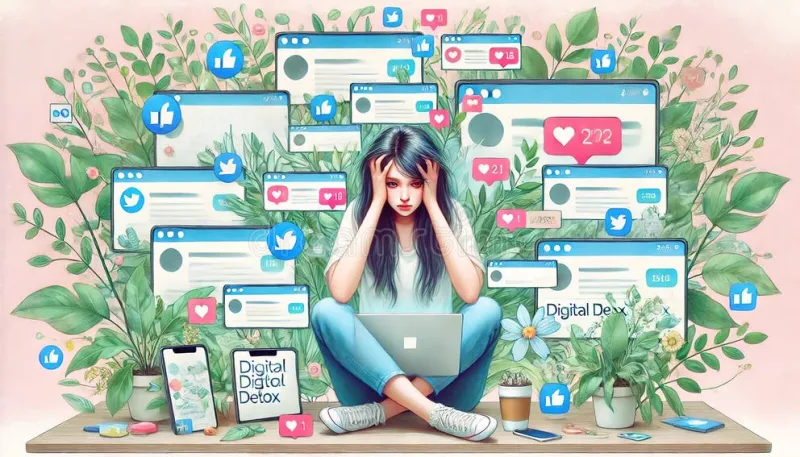
Photo: overwhelmed woman surrounded by smartphones and headphones looking stressed, via thumbs.dreamstime.com
You downloaded three new meditation podcasts last Sunday. You bookmarked a breathing exercise episode you still haven't listened to. You have a sleep soundscape playlist, a morning mindfulness series, and a stress-relief show your coworker swore changed her life. And somehow, looking at all of it sitting there in your app — unplayed, expectant, silently judging — makes you feel worse than before you started.
Sound familiar?
If it does, you're not broken. You're caught in what mental health professionals are increasingly calling the wellness content trap — a psychological loop where the very act of seeking relaxation becomes its own source of pressure. And it's happening to a lot of Americans right now.
The Optimization Problem
America loves to optimize. We track our steps, score our sleep, and grade our hydration. So it probably shouldn't surprise anyone that we've started trying to perform relaxation, too.
Dr. Renee Castillo, a licensed therapist based in Austin, Texas, says she's seen a noticeable uptick in clients who describe feeling guilty about how they unwind. "People come in and tell me they know they should be meditating, they know they should be listening to these podcasts — but every time they sit down to do it, they feel this pressure to do it correctly," she explains. "Relaxation becomes a task. And tasks create anxiety."
The problem is partly structural. Wellness podcasts — even the genuinely excellent ones — are built around the idea that there's a right way to feel better. Follow these steps. Practice this technique. Breathe like this. And while that guidance is genuinely useful in small doses, consuming it in large quantities can quietly rewire how you think about your own mental state.
Instead of asking how do I feel right now?, you start asking am I feeling this correctly?
Your Brain Doesn't Know It's Supposed to Relax
Here's the neuroscience of what's actually going on.
When you listen to a podcast that tells you to relax, your brain doesn't automatically comply just because someone with a soothing voice asked nicely. What it does do is evaluate the situation. And if your nervous system is already running hot — which, for most American adults in 2024, it pretty much always is — that evaluation process can trigger what researchers call evaluative self-focus.
In plain English: you start watching yourself try to relax, which makes relaxing basically impossible.
Neuroscientist and mindfulness researcher Dr. Marcus Webb, who consults with behavioral wellness programs in the Pacific Northwest, describes it this way: "The prefrontal cortex is involved in monitoring and self-regulation. When we consume a lot of prescriptive wellness content, we can accidentally activate that monitoring function during moments that should be passive and restorative. You're essentially putting your brain's inner critic in charge of your recovery time."
This is also why people who listen to the most wellness content aren't always the most relaxed. Consumption and integration are two very different things.
The Playlist That Never Gets Shorter
There's also something worth naming about the sheer volume of wellness content available right now. Podcast apps are overflowing with it. Meditation series, breathwork guides, nervous system resets, sleep hypnosis, anxiety coaching, somatic healing — the options are genuinely endless.
And endless options, as any behavioral economist will tell you, create decision fatigue. When you can't choose what to listen to, or when you feel like you're always missing something better, that cognitive load adds up. You're spending mental energy managing your wellness content library instead of actually resting.
One Reddit thread in a popular US mental health community put it bluntly: "I have 47 saved podcast episodes about anxiety. I am extremely anxious."
The joke landed because so many people recognized themselves in it.
When Self-Improvement Becomes Self-Surveillance
There's a subtler dynamic at work here, too. A lot of wellness podcasting — particularly in the productivity-adjacent corners of the genre — carries an implicit message: you could be doing better. Better sleep. Better focus. Better stress management. Better mornings.
For people who already struggle with anxiety or perfectionism, that message doesn't land as encouragement. It lands as evidence of failure.
"I had a client who stopped listening to wellness podcasts entirely and reported feeling significantly less anxious within two weeks," says Dr. Castillo. "She wasn't avoiding self-care — she was removing a source of chronic low-grade shame she hadn't even identified as a stressor."
That's not an indictment of wellness content as a category. It's a reminder that the relationship you have with that content matters as much as the content itself.
How to Actually Use Wellness Podcasts Without Letting Them Use You
So what's the move? Deleting everything and going analog? Not necessarily. But a few practical shifts can change your whole relationship with the content you're consuming.
Unsubscribe from the backlog mentality. Your podcast queue is not a to-do list. There is no version of this where you've listened to everything you needed to hear. Let episodes expire without guilt. The best episode is the one you actually enjoy, not the one you feel obligated to finish.
Pick one thing and stick with it. Variety feels productive but often isn't. If you find a format that works for you — a specific sleep soundscape, a particular guided breathing series — resist the urge to keep exploring. Consistency builds the neurological pathways that actually make relaxation feel natural over time.
Notice how you feel during, not just after. If a podcast is making you feel tense, critical of yourself, or like you're falling behind on your wellness homework, that's data. You're allowed to turn it off. Seriously.
Separate passive listening from active practice. There's a difference between putting on a calming ambient podcast while you do dishes and sitting down to "do" a meditation episode with graded attention. Both have value, but mixing them up — treating passive listening like a performance — is where a lot of the anxiety creeps in.
Give yourself a content-free window. Even if it's just 20 minutes before bed, try sitting with silence or unstructured sound (a fan, some rain, the neighborhood outside your window) without any audio guidance. Let your brain wander without anyone telling it where to go.
The Deepest Breath You Can Take
Here's the thing about relaxation that no podcast can fully give you: it's not something you achieve. It's something you allow.
The entire premise of wellness content — including, honestly, a lot of what we talk about here at RelaxPods — is that there are tools and techniques that can help you get there. And that's true. Good audio content genuinely can reduce cortisol, ease a racing mind, and help you sleep better. The research on that is solid.
But tools only work when you're not white-knuckling them.
If your podcast habit has started to feel like homework, that's your nervous system telling you something important. Not that you've failed at wellness — but that you might be trying a little too hard to succeed at it.
Sometimes the most radical act of self-care is closing the app, putting down the phone, and just... being here. Unoptimized. Untracked. Ungraded.
Turns out, that's what a lot of us were looking for in the first place.