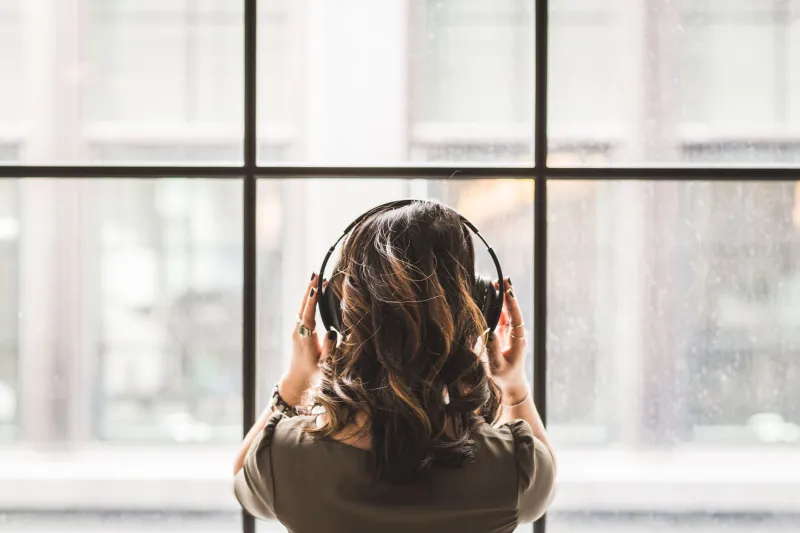
Listening Isn't the Same as Changing: What It Really Takes to Turn Wellness Podcasts Into a New You

There's a particular kind of frustration that wellness podcast fans know well. You've spent months — maybe years — absorbing expert advice on breathwork, sleep hygiene, nervous system regulation, and mindful living. You nod along. You feel genuinely inspired. And then Monday morning hits, and you're back to the same overloaded, under-rested version of yourself who started listening in the first place.
You're not alone, and you're not failing. But you might be misunderstanding what podcasts are actually capable of doing on their own.
The Comfort Trap
Wellness podcasts are genuinely good at a few things. They can lower your heart rate in the moment. They can introduce you to concepts you'd never have encountered otherwise. They can make a lonely commute feel like a conversation with a knowledgeable friend. And there's real value in all of that.
But here's the thing behavioral scientists keep coming back to: exposure to information is not the same as behavior change. Dr. Wendy Wood, a habit researcher at the University of Southern California, has spent decades studying why people don't do what they know they should do. Her conclusion? Knowledge accounts for a surprisingly small slice of what drives our daily behavior. Most of what we actually do is driven by context, repetition, and environmental cues — not insight.
In other words, learning about a stress-reduction technique while you're half-asleep on your couch is a very different neurological event than practicing that technique when your boss drops a last-minute deadline on a Friday afternoon.
Why Your Brain Doesn't Automatically Connect the Dots
When you listen to a podcast, your brain is largely operating in what neuroscientists call a "receptive state." You're taking in information, maybe forming loose associations, perhaps feeling emotionally moved. But the prefrontal cortex — the region responsible for planning, decision-making, and translating intention into action — isn't getting much of a workout.
Actual behavior change requires what researchers call "implementation intentions." This is a term coined by psychologist Peter Gollwitzer, and it describes something very specific: not just wanting to do something, but mentally linking a cue to a response. Something like, "When I feel my shoulders creep up toward my ears during a work call, I will take three slow exhales before I respond."
That kind of concrete, situational planning activates different neural pathways than passive listening does. It's the difference between watching a cooking show and actually chopping vegetables. One feels productive. Only one produces dinner.
The Gap Between Inspired and Integrated
Here's where the paradox really lives. Wellness podcasts are extraordinarily good at generating inspiration — that warm, motivated feeling you get when someone articulate and calm explains exactly why your nervous system is fried and exactly what you could do about it. That feeling is real. The neurochemistry behind it is real.
But inspiration has a half-life. Research published in the Journal of Personality and Social Psychology found that motivational states tend to fade within hours if they're not anchored to a specific behavior or environment. So if your podcast ends and you immediately pick up your phone to check email, that inspired feeling gets overwritten pretty fast.
The fix isn't to listen more. It's to listen differently.
What Actually Bridges the Gap
So what does work? A few evidence-backed strategies are worth building into your listening habits:
Pause and personalize. When a podcast suggests a technique — box breathing, a body scan, a gratitude practice — stop the episode right there. Don't file it away for later. Do the thing now, even for 60 seconds. This creates an experiential memory that's far stickier than an auditory one.
Make it situational. After you finish an episode, take two minutes to ask yourself: When in my actual life this week could I use this? Be specific. Not "I'll try to be more mindful" but "I'll do a two-minute breathing exercise before I open my laptop every morning." Gollwitzer's research consistently shows that this kind of if-then planning dramatically increases follow-through.
Stack it onto something that already exists. Behavioral scientists call this "habit stacking." If you already make coffee every morning, that's your cue. Link your new practice to that existing anchor. The routine you already have is one of the most powerful tools you've got — use it.
Create accountability, even minimal. Telling one person — a partner, a friend, anyone — that you're trying a specific practice for one week is enough to meaningfully increase your follow-through rate. A 2019 study out of the Dominican University of California found that people who wrote down their goals and shared them with a friend completed significantly more of their intended actions than those who kept goals to themselves.
The Role Podcasts Can Legitimately Play
None of this is a knock on wellness podcasts. As a listening platform rooted in relaxation and mindfulness content, we'd be the first to say that audio has a unique power — it meets you in intimate spaces, it doesn't demand your eyes, and it can genuinely shift your mood in real time.
But the most effective use of a wellness podcast isn't as a destination. It's as a launchpad. Think of each episode as a prompt, not a solution. The episode surfaces an idea. You're the one who has to decide what to do with it.
The listeners who seem to get the most genuine, lasting benefit from wellness content tend to treat it the way an athlete treats a coaching session — not as the training itself, but as guidance that informs what they go practice on their own.
A Simpler Way to Think About It
If you've been listening consistently and still feel stuck, try this reframe: your podcast habit isn't broken. It's just incomplete.
You've been doing the input part really well. Now it's time to build the output side — the small, specific, repeated actions that actually teach your nervous system a new way to respond to stress.
Listen to the episode. Then put the phone down. Do the thing. Even badly. Even for just a minute. That one minute of imperfect practice is doing more neurological work than an hour of inspired listening.
The calm you're looking for isn't hiding inside the next episode. It's waiting on the other side of actually trying.