Relaxation Homework: How the Pressure to Unwind Is Keeping You Wound Up
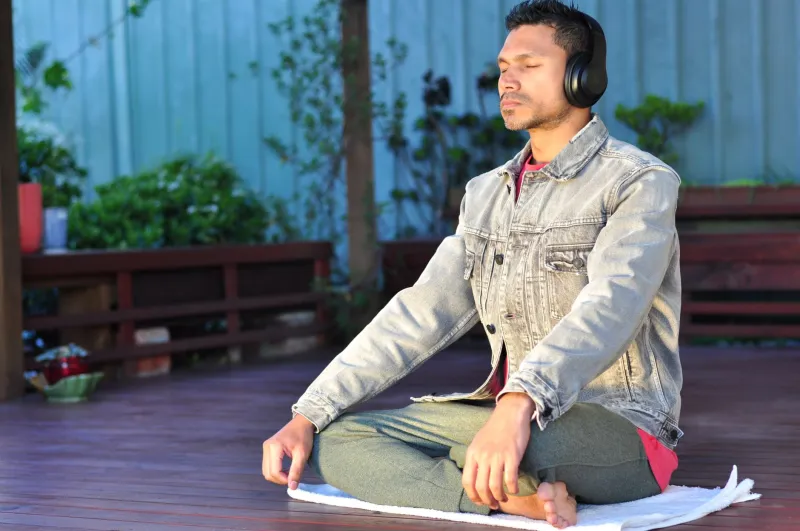
Picture this: you've carved out twenty minutes, found your favorite chair, queued up a guided meditation, and pressed play. The host's voice settles into that familiar, unhurried cadence. Your shoulders should drop. Your breathing should slow. But instead of melting into calm, you're quietly monitoring yourself — checking in every thirty seconds to see if it's working yet.
Sound familiar? You're not broken. You're just caught in one of modern wellness culture's most ironic traps.
When Knowing Too Much Works Against You
There's a psychological concept researchers call ironic process theory, and it explains a lot about why your wellness habits sometimes feel more like obligations than relief. The short version: the harder you try not to think about something, or the more deliberately you chase a specific mental state, the more elusive that state becomes.
Apply that to relaxation podcasts and you get a familiar mess. You've read the articles. You've heard the episode intros. You know that deep breathing activates the parasympathetic nervous system, that mindfulness reduces cortisol, that a consistent listening routine can meaningfully lower your baseline stress. That knowledge is genuinely useful — until it becomes a performance rubric.
Once you start grading yourself against what the episode promised, you've turned a rest stop into an exam. And nobody relaxes well under exam conditions.
The Commercialization of Calm
Wellness in America has become a serious industry — one estimated to be worth hundreds of billions of dollars. Podcast apps, sleep programs, breathwork subscriptions, ambient sound libraries — there's a product for every flavor of anxiety, and most of them come packaged with measurable outcomes.
Fall asleep in under ten minutes. Reduce stress by 40%. Feel centered in just one session.
Those promises aren't entirely hollow. The science behind many relaxation techniques is solid. But when outcomes get marketed this aggressively, listeners start internalizing them as standards. You're no longer just listening to a podcast — you're attempting to hit a benchmark. And the moment you start measuring your calm, you've introduced the very tension you were trying to dissolve.
This is what some wellness researchers describe as outcome-based listening: engaging with content not for the experience itself, but for a specific result you feel you owe yourself. It's the mental equivalent of eating a salad while resenting every bite because it isn't a burger. The behavior is technically correct, but the internal experience undermines the whole point.
The 'Doing It Wrong' Spiral
Here's where things get particularly thorny for a lot of listeners. When a session doesn't produce the expected feeling — when you finish a thirty-minute body scan and still feel tense — the natural response is self-criticism. I must be doing this wrong. Other people clearly get more out of this than I do. Maybe I'm just too stressed to relax.
That internal monologue is its own stress event. Your nervous system doesn't distinguish between anxiety about a work deadline and anxiety about failing to meditate correctly. Either way, it registers a threat, and it responds accordingly.
So you end the session feeling worse than when you started, which makes you more motivated to get it right next time, which adds more pressure to the next session. It's a loop, and it's surprisingly common among people who are genuinely committed to their wellness routines.
Shifting the Frame: From Achievement to Attendance
The fix isn't to abandon your podcast habit or stop caring about your mental health. It's to quietly renegotiate what you're actually showing up for.
Think of it less like a workout — where reps and results matter — and more like sitting on a porch. You're not trying to achieve anything by being on the porch. You're just there. Maybe you notice a bird. Maybe you don't. The value is in the being, not the doing.
Some practical ways to ease into that mindset:
Drop the debrief. After a session, resist the urge to assess how well it went. No mental scorecards. If you caught yourself distracted seventeen times, that's fine. Noticing distraction is part of the practice — it's not evidence that you failed it.
Separate the content from the outcome. You can appreciate a beautifully produced guided meditation without needing it to deliver a specific emotional result. Enjoy the craft of it — the pacing, the voice, the soundscape — without treating it as a prescription you need to fill.
Give yourself permission to feel whatever you feel. Some sessions will leave you genuinely lighter. Others will feel neutral, or even a little frustrating. Both are valid listening experiences. Calm isn't a grade you earn; it's something that shows up on its own schedule.
Shorten your sessions without guilt. Longer isn't always more effective, especially if you're spending the back half of a forty-minute episode anxiously waiting to feel transformed. A focused ten minutes with low expectations often does more good than a marathon session you're half-dreading.
The Paradox at the Heart of It
Here's the uncomfortable truth the wellness industry doesn't always lead with: genuine relaxation is fundamentally passive. You cannot force your nervous system to downregulate any more than you can force yourself to fall asleep by trying harder. The trying is the obstacle.
The best relaxation podcast in the world can create the conditions for ease — a calm voice, a thoughtful script, a well-mixed soundscape — but it can't do the releasing for you. And the releasing, it turns out, only happens when you stop grading it.
That's not a failure of the format. It's just how human nervous systems work. The podcasts are good. The science is real. But somewhere between the content and the listener, there's a gap where the pressure sneaks in — and that gap is worth paying attention to.
Finding Your Way Back to Easy
If any of this resonates, you're probably not someone who needs to listen to more wellness content. You might actually need to listen with less investment for a while.
Put something on without reading the episode description first. Skip the intro that tells you what you're about to experience. Let it wash over you the way you'd let background music wash over you at a coffee shop — present, but not performing.
Relaxation, at its core, isn't something you learn and execute. It's something you allow. The podcasts are here to help you remember what that feels like — not to give you a new thing to be good at.
Breathe deep. Listen well. And maybe, just this once, let go of whether it's working.